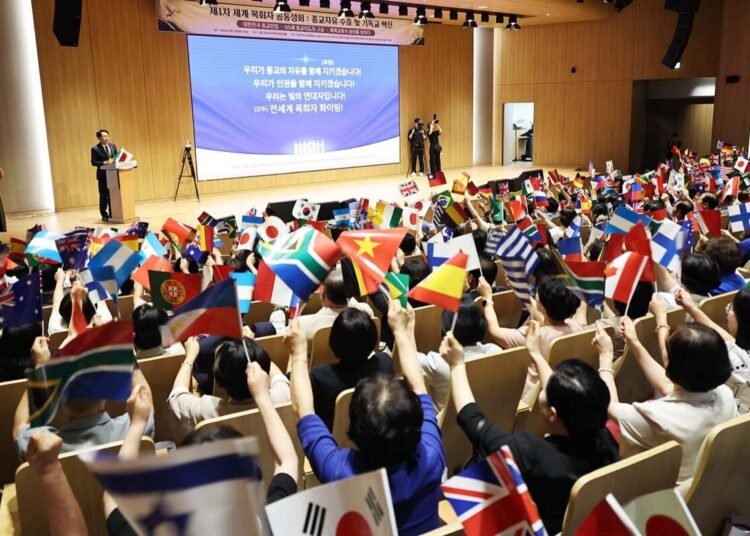
On 13 August, seven religious organizations — including the Council for Christian Mutual Growth, the Korea Christian Leaders Training Institute, the Pastors Alliance for Life and Human Rights, the Russian Evangelical Alliance, and the Thai Evangelical Alliance Association — held the “1st Joint Assembly of World Pastors” and sharply criticized the violations of religious freedom and the undermining of the principle of separation of church and state now taking place in the Republic of Korea. Some 3,000 pastors from major countries around the world attended online and offline.
Not only Korean presenters but also overseas pastors from countries such as Russia and Zambia took the podium themselves, examining from an international perspective the reality of religious freedom under threat. The presenters spoke with one voice: “What is happening in the Republic of Korea today is not the problem of one denomination or one country.” The gathering focused in particular on the pretrial detention of 95-year-old Shincheonji Chairman Lee Man-hee, describing it as a trial by public opinion and a human-rights concern.
The first presenter, Rev. Im Young-woong, senior pastor of Saehimang (New Hope) Church of the Presbyterian Church of Korea, raised the dangers of the debate over dissolving religious corporations. He asked, “If the state can dissolve a single religious organization, exactly how far should that standard reach — and who can guarantee that the standard created today will not be applied to another church tomorrow?” Citing the case in which the Tokyo District Court issued a dissolution order in March 2025 against the former Unification Church and the Supreme Court of Japan finalized it in June 2026, he noted that what was dissolved was not the faith itself but its legal status as a religious corporation, while the practical impact — loss of tax benefits, liquidation of assets — was by no means small.
Rev. Im pointed to Article 38 of Korea’s Civil Act, which allows a corporation’s establishment permit to be revoked for “acts that harm the public interest,” asking, “Who decides what harms the public interest, and by what standard?” He recalled the 2020 case in which the Seoul Metropolitan Government revoked the permit of an association linked to Shincheonji and began proceedings against HWPL, and a December 2025 order to review dissolving domestic religious organizations. “The most dangerous thing is that it is not objective criminal facts but ‘social unpopularity’ that operates as grounds for dissolution,” he warned, invoking Article 18 of the International Covenant on Civil and Political Rights: “Religious freedom must not vary according to whether a religion is old or new, a majority or a minority, or socially popular or condemned.”
Rev. Vitaly Kirillovich Vlasenko, General Secretary of the Russian Evangelical Alliance, presented on the theme “Public opinion cannot be a verdict.” He said, “The fact that hundreds of thousands condemn someone and that countless media reports follow cannot justify declaring a person guilty before the court has even handed down its judgment.” Recalling that in 2020, as Shincheonji was linked to the spread of COVID-19 in Daegu, a national petition demanding its forced dissolution surpassed 500,000 signatures within two days and later exceeded one million, he noted that the Supreme Court of Korea ultimately acquitted Chairman Lee of violating the Infectious Disease Control and Prevention Act. “The stronger the social pressure, the more fair and neutral the trial must be,” he said, urging that the legal standard be applied equally to everyone.
Baca Juga


Bishop Elias Elijah Changa, founder and president of the Zambia-based Missionary Ambassadors for Global Evangelism (MAGE), raised questions of due process and human dignity drawn from his prison-ministry experience. “The administration of justice and the protection of human dignity must go together,” he said. Noting that detention causes especially serious hardship for the elderly, he asked the authorities to consider lawful alternatives such as bail, residence restriction, or medical accommodation: “We are not demanding that Chairman Lee Man-hee receive special treatment because he is a religious leader; we are asking that the fairness, dignity, and universal rights owed to everyone be extended equally to him.”
The assembly closed with a Joint Statement adopted with the signatures of Christian leaders from around the world. It called on the government and political circles to immediately cease using specific religions, including Shincheonji, as tools of political strife in violation of the separation of church and state; urged the judiciary to halt trials by public opinion and uphold the presumption of innocence for the very elderly religious leader; and asked the court to grant his bail request and release him immediately. “The cases presented here are not the problem of one denomination alone but a grave warning signal spanning religious freedom in the Republic of Korea as a whole,” the organizers said, pledging to continue in solidarity with international human-rights organizations and the churches of the world.